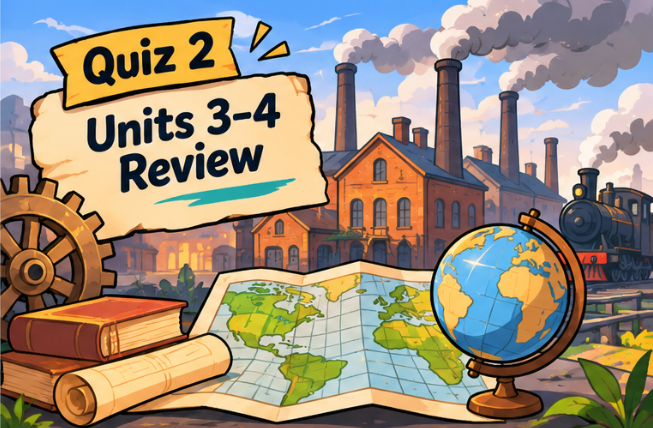
The questions
- 1
Which phrase means producing a large number of products?
- Find a route
- Move to the cities
- Produce in mass quantities
- Work long hours
Answer: Produce in mass quantities
- 2
Where did many people move during the Industrial Revolution?
- To the cities
- To the coast
- To the countryside
- To the mountains
Answer: To the cities
- 3
Which phrase describes a difficult feature of factory work during the Industrial Revolution?
- Carry passengers
- Find a route
- Show climate
- Work long hours
Answer: Work long hours
- 4
Which type of map shows roads and places?
- A climate map
- A physical map
- A road map
- A satellite map
Answer: A road map
- 5
Which type of map shows features such as mountains and oceans?
- A climate map
- A physical map
- A road map
- A route map
Answer: A physical map
- 6
Which type of map is used to show climate information?
- A climate map
- A physical map
- A road map
- A street map
Answer: A climate map
- 7
Which type of map can show weather information from space?
- A physical map
- A road map
- A route map
- A satellite map
Answer: A satellite map
- 8
In the sentence "A road map shows roads and places, so it can help a driver find a route," which word connects the information with its result?
- According
- Before
- During
- So
Answer: So
- 9
Which is the best way to make useful academic notes from a source?
- Copy every sentence
- Memorise the whole text
- Select important key words
- Write personal opinions
Answer: Select important key words
- 10
Which strategy is most useful when you need to locate one specific fact quickly in a text?
- Giving a presentation
- Memorising every paragraph
- Scanning
- Writing a summary
Answer: Scanning
- 11
Which word is connected with machines used to produce goods during the Industrial Revolution?
- Capillary
- Climate
- Crater
- Machinery
Answer: Machinery
- 12
Which sentence correctly describes historical change?
- People are moving to cities before history
- People move to the cities tomorrow
- People moved to the cities during the Industrial Revolution
- People will move during the Industrial Revolution
Answer: People moved to the cities during the Industrial Revolution
- 13
What is a route?
- A body system
- A factory machine
- A type of climate
- A way from one place to another
Answer: A way from one place to another
- 14
Which sentence makes a comparison between two maps?
- A climate map shows climate
- A road map shows roads
- A satellite map is used from space
- Both maps show geographical information
Answer: Both maps show geographical information
- 15
Why should students use key words when taking notes?
- To avoid reading the source
- To copy the whole source
- To make the notes longer
- To remember important information more easily
Answer: To remember important information more easily
- 16
Which information should be included in a source-based summary?
- Facts invented by the writer
- Information supported by the source
- Personal opinions about the topic
- Unrelated background information
Answer: Information supported by the source