The questions
- 1
What is the smallest unit of life, the building block of every living thing?
- The atom
- The cell
- The organ
- The tissue
Answer: The cell
- 2
Which part holds the cell's genetic material and controls what the cell does?
- The cell wall
- The cytoplasm
- The nucleus
- The vacuole
Answer: The nucleus
- 3
Which part controls what goes into and out of the cell?
- The cell membrane
- The cell wall
- The chloroplast
- The nucleus
Answer: The cell membrane
- 4
What is the jelly-like substance where most of the cell's chemical reactions happen?
- The cell wall
- The cytoplasm
- The nucleus
- The vacuole
Answer: The cytoplasm
- 5
In which part does aerobic respiration release energy from glucose?
- The chloroplasts
- The mitochondria
- The nucleus
- The ribosomes
Answer: The mitochondria
- 6
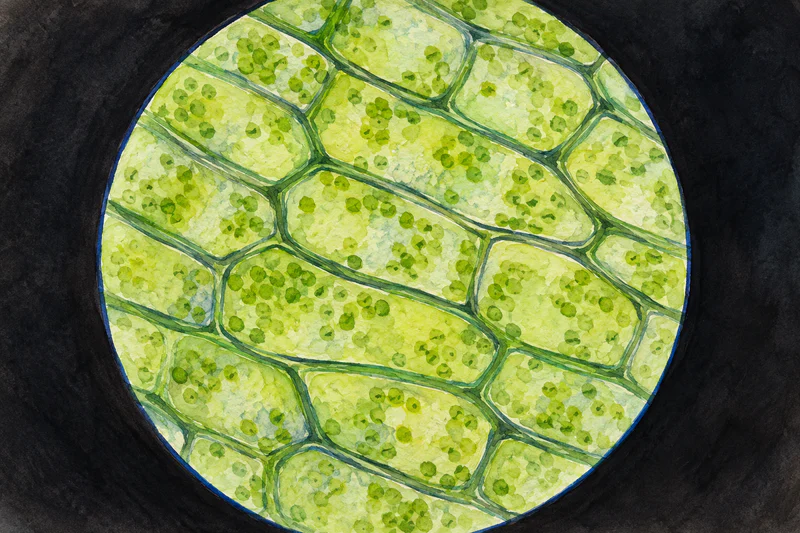
Which part of a plant cell carries out photosynthesis?
- The cell wall
- The chloroplasts
- The mitochondria
- The vacuole
Answer: The chloroplasts
- 7
Which of these do plant cells have, but animal cells do not: a nucleus, a cell wall, a cell membrane, or mitochondria?
- A cell membrane
- A cell wall
- A nucleus
- Mitochondria
Answer: A cell wall
- 8
What is the job of the large vacuole in a plant cell?
- It controls everything the cell does
- It holds cell sap and keeps the cell firm
- It lets gases in and out of the cell
- It makes food from light and water
Answer: It holds cell sap and keeps the cell firm
- 9
True or false: Plant cells have no mitochondria, because they have chloroplasts.
- False: plant cells have both
- True: chloroplasts do the job instead
Answer: False: plant cells have both
- 10
Why do root hair cells have no chloroplasts?
- They are too thin to hold any
- They get no light underground
- They get their food from the soil
- They only store starch
Answer: They get no light underground
- 11
Which human cell has no nucleus when it is fully mature?
- A cheek cell
- A muscle cell
- A nerve cell
- A red blood cell
Answer: A red blood cell
- 12
Which cells in your body can be about a metre long?
- Fat cells
- Nerve cells
- Red blood cells
- Skin cells
Answer: Nerve cells
- 13
What do we call a group of similar cells working together?
- A tissue
- An organ
- An organ system
- An organism
Answer: A tissue
- 14
Who named "cells" in 1665, after looking at thin slices of cork through a microscope?
- Charles Darwin
- Isaac Newton
- Louis Pasteur
- Robert Hooke
Answer: Robert Hooke
- 15
Which of these living things is made of just one cell?
- A jellyfish
- A mushroom
- An amoeba
- An earthworm
Answer: An amoeba
- 16
A microscope has a ×10 eyepiece and a ×40 objective lens. What is the total magnification?
- ×4,000
- ×40
- ×400
- ×50
Answer: ×400
- 17
True or false: Bacteria have a nucleus.
- False: their DNA lies loose in the cytoplasm
- True: bacteria have a nucleus like ours
Answer: False: their DNA lies loose in the cytoplasm
- 18
Which plant cells have the most chloroplasts?
- Cork cells
- Onion skin cells
- Palisade cells
- Xylem cells
Answer: Palisade cells
- 19
Roughly how many cells make up an adult human body?
- A few thousand
- About a billion
- About a million
- Tens of trillions
Answer: Tens of trillions
- 20
Which tiny parts of a cell make proteins?
- Cell membranes
- Cell walls
- Ribosomes
- Vacuoles
Answer: Ribosomes