The questions
- 1
What does DNA stand for?
- Deoxyribonucleic acid
- Deoxyribose nitrogen atom
- Dinucleotide amino acid
- Double nuclear acid
Answer: Deoxyribonucleic acid
- 2
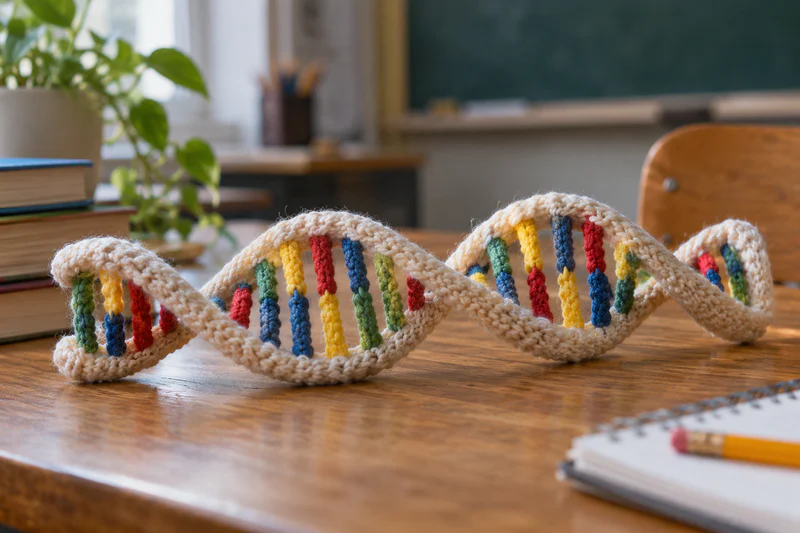
DNA is shaped like a twisted ladder. What do we call this shape?
Answer: A double helix
- 3
Where is most of the DNA in one of your cells?
- In the cell membrane
- In the nucleus
- In the ribosomes
- In the vacuole
Answer: In the nucleus
- 4
What do we call a section of DNA that carries the instructions for making one protein?
- A cell
- A chromosome
- A gene
- A nucleus
Answer: A gene
- 5
How many chromosomes are in most human body cells?
- 23
- 46
- 48
- 92
Answer: 46
- 6
How many chromosomes are in a human egg cell or sperm cell?
- 12
- 23
- 46
- 92
Answer: 23
- 7
Which of these features is inherited?
- A scar on your knee
- Dyed blue hair
- Speaking French
- Your natural hair colour
Answer: Your natural hair colour
- 8
Which of these is learned, not inherited?
- Your blood group
- Your natural eye colour
- Your natural skin tone
- Your skill at riding a bike
Answer: Your skill at riding a bike
- 9
What do we call different versions of the same gene?
- Alleles
- Clones
- Genomes
- Nuclei
Answer: Alleles
- 10
What is true about a dominant allele?
- It always comes from the father, never the mother
- It is always the most common one in a population
- It only works in plants, not in animals
- It shows its effect even if there is only one copy
Answer: It shows its effect even if there is only one copy
- 11
Who worked out the basic rules of inheritance by growing thousands of pea plants?
- Charles Darwin
- Gregor Mendel
- Isaac Newton
- Louis Pasteur
Answer: Gregor Mendel
- 12
In pea plants, tall (T) is dominant over short (t). What does a Tt plant look like?
- Half tall, half short
- Medium height
- Short
- Tall
Answer: Tall
- 13
Two Tt pea plants are crossed. What fraction of their offspring do we expect to be short (tt)?
- None of them
- One in four (25%)
- One in two (50%)
- Three in four (75%)
Answer: One in four (25%)
- 14
Whose X-ray photographs of DNA helped Watson and Crick work out its shape in 1953?
- Ada Lovelace
- Jane Goodall
- Marie Curie
- Rosalind Franklin
Answer: Rosalind Franklin
- 15
Why do identical twins look so alike?
- They always eat the same food
- They grew up in the same house together
- They share the same DNA
- They were born on the same day
Answer: They share the same DNA
- 16
True or false: Whether you can roll your tongue is decided by a single gene.
- False: even some identical twins differ in it
- True: it is passed on like pea plant height
Answer: False: even some identical twins differ in it
- 17
About how many genes does a human have?
- About 2 million
- About 2,000
- About 20,000
- About 46
Answer: About 20,000
- 18
In DNA, the base A always pairs with ___.
- C
- G
- T
- U
Answer: T
- 19
If all the DNA in one of your cells were stretched out, about how long would it be?
- About 2 centimetres
- About 2 kilometres
- About 2 metres
- About 2 millimetres
Answer: About 2 metres