The questions
- 1
What does a food chain show?
- How animals grow
- How plants drink water
- What eats what
- Where animals sleep
Answer: What eats what
- 2
Most food chains start with a green plant. What do we call it?
- A consumer
- A decomposer
- A predator
- A producer
Answer: A producer
- 3
Why do most food chains start with green plants?
- They eat tiny insects
- They grow faster than animals
- They make their own food
- They take ready-made food from the soil
Answer: They make their own food
- 4
Animals have to eat plants or other animals. What do we call them in a food chain?
- Consumers
- Decomposers
- Habitats
- Producers
Answer: Consumers
- 5
Almost every food chain is powered by ___.
- The rain
- The soil
- The Sun
- The wind
Answer: The Sun
- 6
An owl catches and eats mice. For the owl, the mouse is its ___.
- Habitat
- Predator
- Prey
- Producer
Answer: Prey
- 7
What do we call an animal that hunts other animals for food?
- A decomposer
- A herbivore
- A predator
- A producer
Answer: A predator
- 8
Grass → grasshopper → frog → snake. Which living thing is at the top of this food chain?
- The frog
- The grass
- The grasshopper
- The snake
Answer: The snake
- 9
Grass → grasshopper → frog → snake. What does the frog eat?
- The grass
- The grasshopper
- The snake
- The soil
Answer: The grasshopper
- 10
Grass → grasshopper → frog → snake. Which one is both a predator and prey?
- The frog
- The grass
- The grasshopper
- The snake
Answer: The frog
- 11
Which of these is a decomposer?
- A daisy in a field
- A mushroom on a log
- A rabbit in its burrow
- An owl in a tree
Answer: A mushroom on a log
- 12
What do decomposers feed on?
- Dead plants and animals
- Living animals they catch
- Nectar from flowers
- Sunlight and water
Answer: Dead plants and animals
- 13
Why are decomposers good for plants?
- They give plants extra sunlight
- They keep insects off the leaves
- They put nutrients back into the soil
- They water plants when it is dry
Answer: They put nutrients back into the soil
- 14
A vulture feeds on animals that are already dead. What do we call an animal like this?
- A herbivore
- A pollinator
- A producer
- A scavenger
Answer: A scavenger
- 15
Which way do the arrows point in a food chain?
- From the animal to the food it eats
- From the food to the animal that eats it
Answer: From the food to the animal that eats it
- 16
The arrows in a food chain show how ___ passes from one living thing to the next.
- Air
- Energy
- Soil
- Water
Answer: Energy
- 17
Finish the food chain: grass → zebra → ___
- A daisy
- A giraffe
- A lion
- An elephant
Answer: A lion
- 18
The blue whale is the biggest animal on Earth. What does it mainly eat?
- Krill, tiny shrimp-like animals
- Seals, sea mammals with flippers
- Sharks, big fish with sharp teeth
- Squid, soft animals with tentacles
Answer: Krill, tiny shrimp-like animals
- 19
What do we call lots of food chains linked together?
- A food group
- A food web
- A habitat
- A life cycle
Answer: A food web
- 20
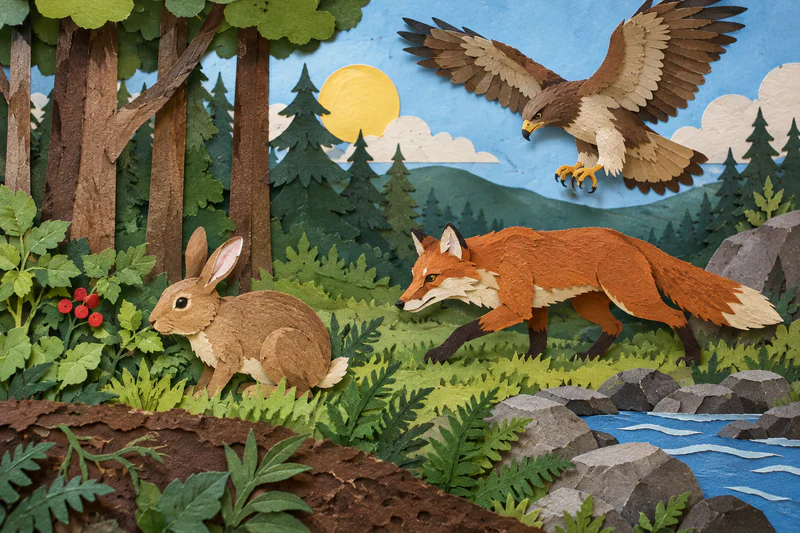
Grass → rabbit → fox. If all the foxes disappeared, what would happen to the number of rabbits at first?
- It would go down
- It would go up
Answer: It would go up
- 21
Grass → rabbit → fox. If there were suddenly many more rabbits, what would happen to the grass?
- Less of it would be left
- More of it would grow
Answer: Less of it would be left